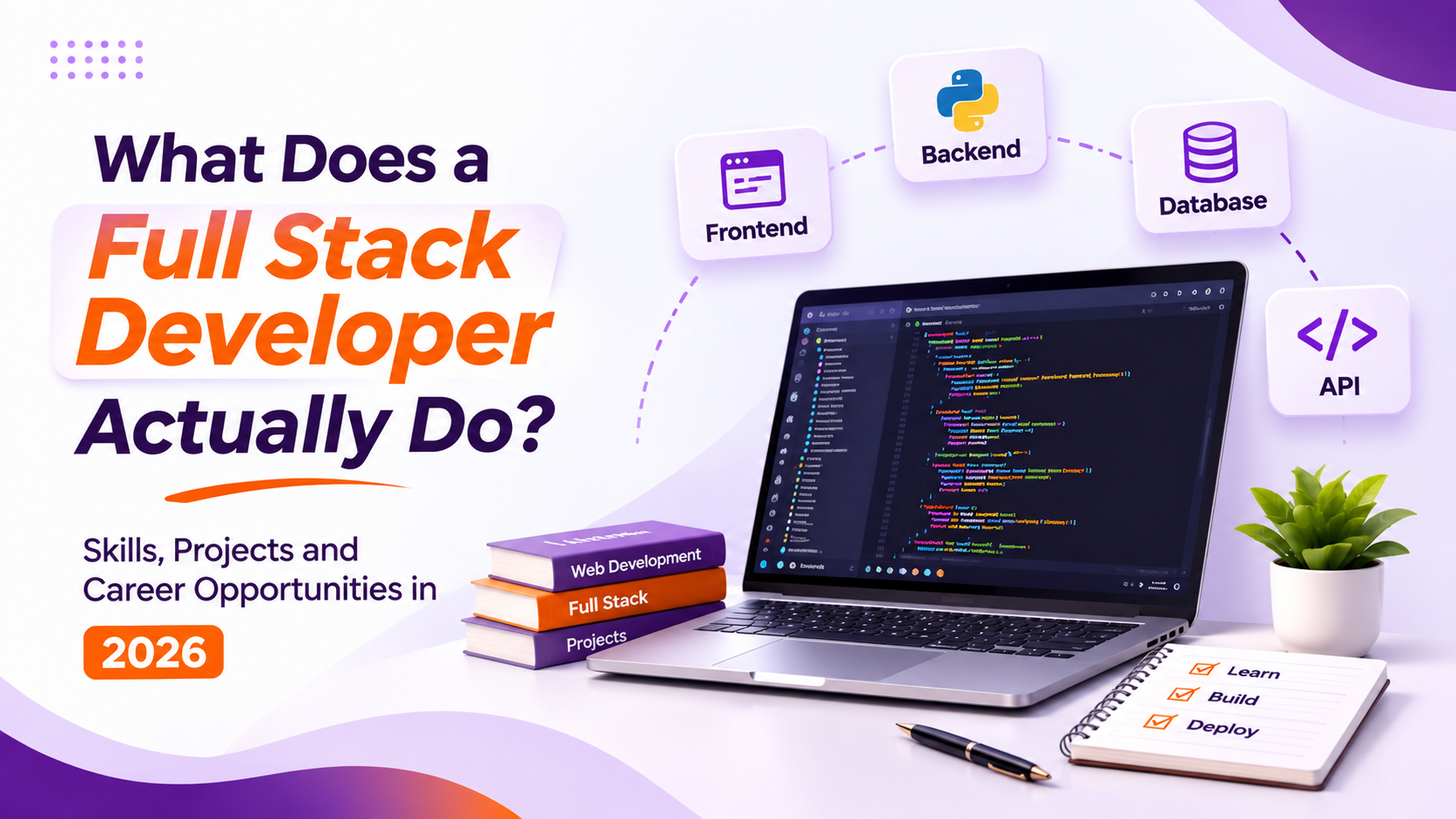
What Does a Full Stack Developer Actually Do? Skills, Projects and Career Opportunities in 2026
Technology is changing the way businesses operate, communicate, and deliver services. From e-commerce websites and banking applications to educational platforms and business management systems, web applications have become an essential part of everyday life.
Behind these applications are skilled software developers who design, build, and maintain the technology that powers them.
One of the most versatile roles in the software development industry is that of a Full Stack Developer.
But what does a Full Stack Developer actually do? Which technical skills are required? What projects should beginners build? And is Full Stack Development a suitable career choice for freshers in 2026?
This guide explains everything you need to know before starting your Full Stack Development journey.
1. What Is Full Stack Development?
Full Stack Development involves building both the front end and back end of a web application. It combines different technologies to create functional, interactive, and user-friendly applications.
A typical web application consists of three main components:
Front-End Development: This is the visual part of an application that users interact with. It includes layouts, buttons, navigation menus, forms, and other interface elements.
Back-End Development: This handles server-side operations, application logic, user authentication, and communication between different components.
Database Management: Databases store and organise information such as user details, product information, transactions, and application records.
A Full Stack Developer understands how these components work together and can contribute to the development of a complete web application.
For example, consider an online shopping platform. Users can browse products, add items to their shopping carts, create accounts, and place orders. A Full Stack Developer can work on the different components required to make these features function together.
To understand the technologies involved, explore the Full Stack Development Course at RootAxis.
2. What Does a Full Stack Developer Actually Do?
A Full Stack Developer works across different stages of the software development process. Their responsibilities include designing interfaces, developing application functionality, managing databases, and integrating external services.
Front-End Development
Front-end development focuses on creating the visual and interactive elements of a website or application.
Developers commonly use the following technologies:
- HTML: Defines the structure of web pages. Learn more through MDN HTML Documentation.
- CSS: Controls website layouts, colours, spacing, and styling. Explore the MDN CSS Guide.
- JavaScript: Adds interactive and dynamic functionality. Read the JavaScript Documentation.
- React.js: Helps developers build reusable and interactive user interfaces. Explore the official React documentation.
For example, when users click buttons, submit forms, or navigate between pages, front-end technologies enable these interactions.
Back-End Development
Back-end development focuses on the server-side functionality of an application. It manages application logic, processes user requests, and connects the front end with databases.
Popular back-end technologies include:
- Python
- Java
- Node.js
- PHP
- Express.js
For beginners interested in Python, the official Python documentation provides useful learning resources. Developers exploring JavaScript-based back-end development can refer to the Node.js learning resources.
For instance, when a user creates an account, the back end processes the registration details and communicates with the database to store the required information.
Database Management
Every application needs a reliable way to store and retrieve information.
Full Stack Developers work with database technologies such as:
- MySQL
- PostgreSQL
- MongoDB
For example, an educational platform may use a database to manage student information, course details, attendance records, and payment information.
You can explore database concepts through the official MySQL documentation.
API Integration
Application Programming Interfaces (APIs) allow different software applications and services to communicate with one another.
Developers use APIs to integrate features such as payment gateways, maps, email notifications, and third-party services.
Understanding API integration is an important skill for building modern web applications.
3. Essential Skills Required to Become a Full Stack Developer
You do not need to master every programming language before starting your development journey. However, learning the right combination of technical skills can help you build a strong foundation.
Here are eight important skills to focus on:
1. Programming Fundamentals
Understand variables, data types, conditional statements, loops, functions, and object-oriented programming concepts.
2. HTML and CSS
Learn how to structure web pages, create layouts, and develop responsive user interfaces.
3. JavaScript
Understand functions, events, DOM manipulation, asynchronous programming, and other essential concepts.
4. Front-End Frameworks
Explore technologies such as React.js to develop modern, reusable, and interactive user interfaces.
5. Back-End Programming
Choose a back-end technology such as Python, Java, or Node.js. Learn how server-side applications process requests and manage business logic.
6. Database Management
Learn how to create database tables, manage records, write SQL queries, and connect databases to applications.
7. Git and GitHub
Understand version control and learn how to manage code changes, collaborate with other developers, and maintain project history. Start with the official Git documentation.
8. Problem-Solving Skills
Develop the ability to analyse problems, identify possible solutions, and write efficient code.
4. Real-World Projects You Can Build as a Full Stack Developer
Understanding programming concepts is important, but practical implementation helps you learn how complete applications work.
Building projects also gives you opportunities to demonstrate your technical knowledge and problem-solving abilities.
Here are five useful project ideas for beginners:
1. Student Management System
Develop an application that allows administrators to manage student records, course details, attendance, and academic information.
2. Online Shopping Application
Build an e-commerce platform with product listings, user registration, shopping cart functionality, and order management.
3. Job Portal Application
Create a platform where employers can publish job openings, and candidates can register, search for opportunities, and submit applications.
4. Learning Management System
Develop an educational platform where students can access learning materials, explore courses, and track their learning progress.
5. Appointment Booking System
Create an application that allows users to select services, view available time slots, and schedule appointments.
These projects help beginners understand how front-end interfaces, back-end logic, databases, and APIs work together.
5. Career Opportunities After Learning Full Stack Development
Full Stack Development provides a foundation for exploring different roles in the software development industry.
Depending on your technical knowledge, practical experience, and project portfolio, you can work towards positions such as:
- Junior Full Stack Developer
- Front-End Developer
- Back-End Developer
- Web Developer
- React Developer
- Python Developer
- Java Developer
- Software Developer
Businesses across different industries require professionals who can develop, maintain, and improve digital applications.
However, completing a training programme alone does not guarantee employment. Practical knowledge, problem-solving abilities, project experience, and interview preparation also play important roles in career development.
If you need help choosing a suitable technology career path, explore Career Guidance at RootAxis.
6. Is Full Stack Development Suitable for Freshers?
Yes. Full Stack Development can be a suitable learning path for college students, recent graduates, and beginners interested in software development.
You do not necessarily need previous professional programming experience to get started.
A structured learning approach can help beginners gradually develop their technical abilities.
Here is a suggested learning sequence:
- Learn programming fundamentals.
- Understand HTML, CSS, and JavaScript.
- Explore front-end frameworks.
- Learn back-end programming.
- Understand database management.
- Practise API integration.
- Develop real-world projects.
- Create a GitHub portfolio.
- Prepare for technical interviews.
Students from non-IT backgrounds can also explore Full Stack Development by starting with basic programming concepts and progressing through practical exercises.
7. How Long Does It Take to Learn Full Stack Development?
The time required to learn Full Stack Development depends on your existing knowledge, learning schedule, and consistency.
Beginners should focus on understanding each concept rather than rushing through multiple technologies.
A structured learning roadmap may include the following stages:
Learning StageTopics to LearnFoundationProgramming basics, HTML and CSSFront-EndJavaScript and React.jsBack-EndPython, Java or Node.jsDatabaseMySQL or MongoDBIntegrationAPIs and application developmentPractical LearningReal-world projects and portfolio development
Regular coding practice, project development, and continuous improvement can help learners become more confident in their technical abilities.
8. Why Is Practical Training Important in Full Stack Development?
Understanding programming syntax is only one part of becoming a developer. You also need to know how to apply that knowledge when developing actual applications.
Practical training provides opportunities to:
- Understand real-world development workflows.
- Build applications from the beginning.
- Identify and resolve programming errors.
- Integrate front-end and back-end components.
- Work with databases and APIs.
- Develop a portfolio to demonstrate technical skills.
- Improve problem-solving and debugging abilities.
A project-based learning approach helps students connect theoretical concepts with practical software development.
Explore the RootAxis Full Stack Course to learn about its curriculum, technologies, practical projects, and training structure.
9. Start Your Full Stack Development Journey with RootAxis
Are you a student, fresher, or aspiring software developer looking to develop your technical skills?
RootAxis offers technology-focused training opportunities for learners who want to explore programming and software development.
Through structured learning and practical project development, students can work towards understanding essential technologies and building their own applications.
Whether you are starting with programming fundamentals or looking to strengthen your development knowledge, choosing the right learning approach can help you move closer to your career goals.
Start learning. Build real projects. Develop your future in technology.
Explore the Full Stack Development training programme at RootAxis and take your first step towards becoming a software developer.
Visit: https://rootaxis.in/
Frequently Asked Questions
1. What does a Full Stack Developer do?
A Full Stack Developer works on both front-end and back-end development. Their responsibilities include developing user interfaces, managing application logic, working with databases, and integrating APIs.
2. Can beginners learn Full Stack Development?
Yes. Beginners can start with programming fundamentals and gradually learn front-end development, back-end technologies, and database management.
3. Which programming language is best for Full Stack Development?
Python, Java, and JavaScript are popular choices. The most suitable language depends on your learning goals and preferred technology stack.
4. Is Full Stack Development a good career choice in 2026?
Full Stack Development can be a valuable career path for individuals interested in software engineering. Practical skills, project experience, and continuous learning are important for professional growth.
5. Do Full Stack Developers need to learn databases?
Yes. Database knowledge is essential for storing, retrieving, and managing application information.
6. What projects should beginners build?
Beginners can start with student management systems, e-commerce applications, job portals, learning management systems, and appointment booking applications.
7. Can non-IT students become Full Stack Developers?
Yes. Students from non-IT backgrounds can learn Full Stack Development by starting with programming fundamentals and gradually developing their technical knowledge through practice.
Conclusion
Full Stack Development is more than learning programming languages. It involves understanding how complete applications are designed, developed, integrated, and maintained.
By learning front-end technologies, back-end programming, database management, and API integration, beginners can develop the technical foundation required to explore software development careers.
Start with the fundamentals, practise consistently, and build projects that demonstrate your abilities.
Your journey towards becoming a Full Stack Developer begins with the first step.