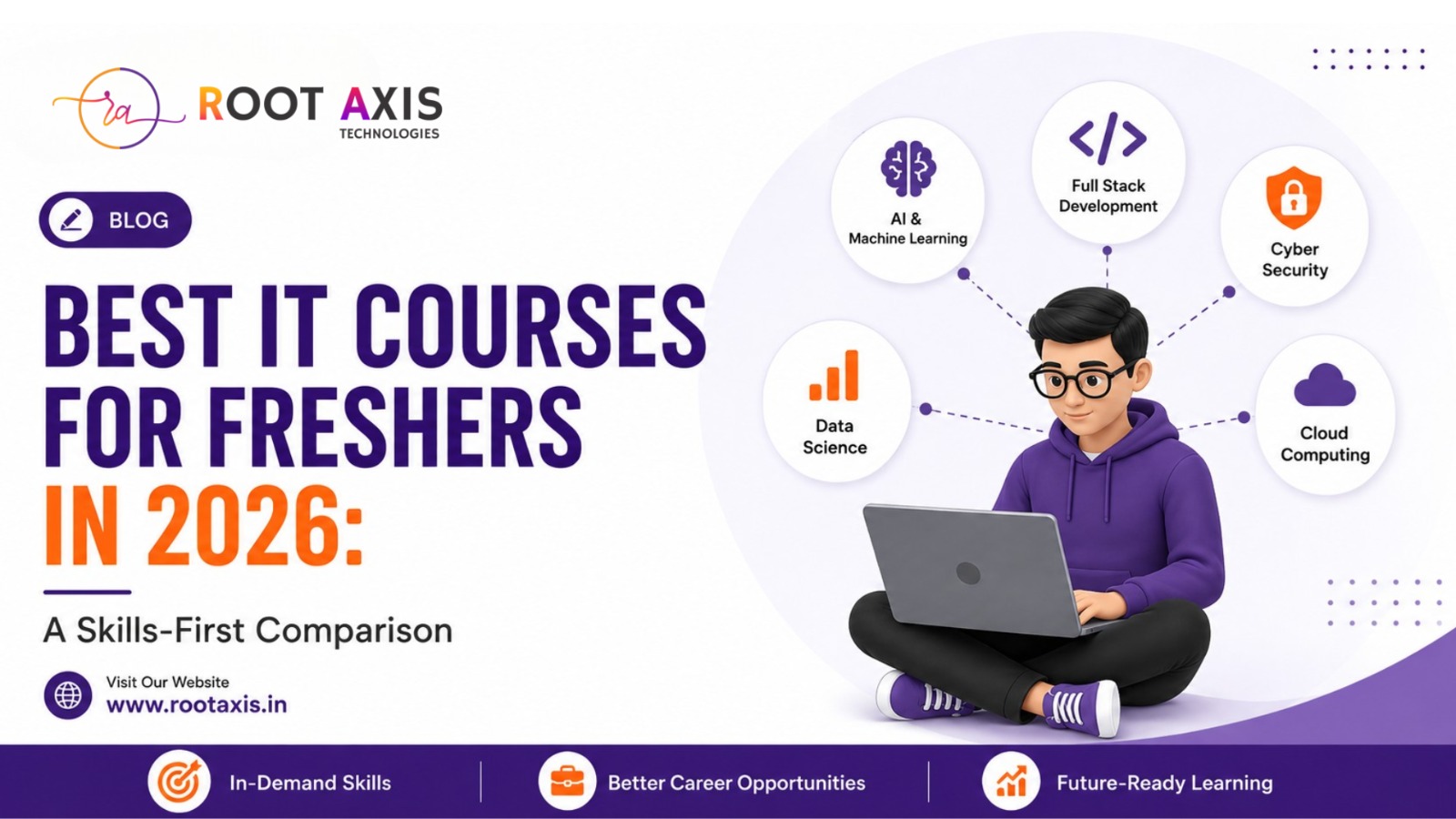
Best IT Courses for Freshers in 2026: A Skills-First Comparison
Walk into any hiring conversation in 2026 and you'll notice something has quietly changed: nobody asks for your degree first anymore. They ask what you can actually build, fix, or analyze. For freshers trying to break into IT, that shift is both intimidating and freeing. It means a well-chosen course can matter more than a four-year degree ever did but only if you pick the right one for the right reason, not because it's trending on social media.
This guide compares the courses freshers are actually getting hired for right now, breaks down what each one really involves, and helps you match a path to your own strengths rather than chasing whatever sounds most impressive.
Why "Skills-First" Matters More Than Ever
Companies today build hiring pipelines around demonstrated ability. A candidate who can walk through a real project, explain their design decisions, and show working code or a live dashboard beats a candidate with a longer resume but nothing to show for it. This is why almost every serious IT course in 2026 is built around projects, not just lecture slides. When comparing courses, the first filter should always be: does this course end with something I can show an interviewer, or just a certificate I can mention?
With that filter in mind, here's how the major paths stack up.
1. Full Stack Development
Full stack development remains one of the most dependable entry points into tech, and for good reason: nearly every company, regardless of industry, needs people who can build and maintain web applications.
What you actually learn: A programming language (commonly Python or JavaScript), frontend frameworks for building user interfaces, backend logic for handling data and requests, databases, and how to deploy an application so real users can access it.
Best for: People who enjoy seeing immediate, visual results from their work and like solving concrete problems end-to-end.
Entry roles: Junior Developer, Frontend Engineer, Backend Engineer, Software Engineer Trainee.
Reality check: This field is more saturated than it was five years ago, so a course alone won't cut it — you need a portfolio of 3 to 4 original projects, not tutorials you followed step by step.
2. Artificial Intelligence and Machine Learning
AI and ML continue to sit at the top of hiring demand, driven by companies embedding automation and predictive tools into nearly every product line.
What you actually learn: Python programming, statistics and probability, data modeling, neural network fundamentals, and how to work with pre-trained models rather than building everything from scratch.
Best for: Freshers who are comfortable with math and enjoy experimenting to see why a model behaves the way it does.
Entry roles: AI Engineer Trainee, Machine Learning Associate, Data Scientist (junior).
Reality check: This is the most competitive field on this list. It rewards freshers who go deep on a narrow, well-documented project — like a working automation tool or a small predictive system — rather than those who claim broad theoretical knowledge without proof of application.
3. Data Analytics and Data Science
Not every company needs someone building AI models, but nearly every company needs someone who can turn raw data into decisions. That's the gap data analytics fills.
What you actually learn: SQL, Excel and spreadsheet modeling, Python or R for analysis, data visualization tools like Power BI or Tableau, and how to present findings clearly to non-technical stakeholders.
Best for: Freshers who like structure, pattern-finding, and communicating insights rather than writing large amounts of code.
Entry roles: Data Analyst, Business Analyst, Reporting Analyst.
Reality check: This path has one of the shortest distances between "course completion" and "job-ready," because the tools are approachable and the output (a clear dashboard or report) is easy to demonstrate in an interview.
4. Cloud Computing (AWS, Azure, Google Cloud)
As more companies move infrastructure off physical servers, cloud skills have become close to mandatory for many technical roles, not just a specialization.
What you actually learn: How cloud platforms are structured, deploying and managing virtual servers, storage and networking basics, and platform-specific certifications like AWS Cloud Practitioner or Azure Fundamentals.
Best for: Freshers who like systems thinking — understanding how pieces of infrastructure connect rather than writing application code.
Entry roles: Junior Cloud Engineer, Cloud Support Associate, DevOps Trainee.
Reality check: Certifications carry real weight here because cloud platforms are standardized products; an AWS or Azure certificate is a recognizable, verifiable signal to employers in a way that a generic "cloud course" isn't.
5. Cybersecurity
As digital operations expand, so does the attack surface companies need to defend — which is why cybersecurity hiring has stayed strong even in years when other tech hiring slowed down.
What you actually learn: Networking fundamentals, common attack methods and how to defend against them, security tools for monitoring and testing systems, and foundational certifications like CompTIA Security+ or CEH.
Best for: Freshers who enjoy investigative thinking — spotting what's out of place and reasoning through how a system could be broken.
Entry roles: SOC Analyst (Level 1), Junior Security Analyst, IT Security Support.
Reality check: Employers in this space value hands-on lab experience (simulated attacks and defenses) far more than memorized theory, so prioritize courses with practical lab access.
6. Networking (CCNA and Beyond)
Every other technology on this list runs on top of a network, which is why networking remains a steady, underrated entry path — especially for freshers who want a clear certification ladder.
What you actually learn: Routing and switching fundamentals, network security basics, and structured certifications starting with CCNA and progressing toward CCNP.
Best for: Freshers who prefer a well-defined, step-by-step certification path over open-ended project work.
Entry roles: Network Support Engineer, Junior Network Administrator.
Reality check: Growth in this field tends to be steady rather than explosive — a dependable long-term career, but not the fastest path to a high starting salary.
7. Business Tools: Power BI, SAP, and ServiceNow
A quieter but consistently in-demand category is enterprise software — the tools large organizations run their internal operations on.
What you actually learn: Platform-specific skills for reporting (Power BI), enterprise resource planning (SAP), or IT service management (ServiceNow).
Best for: Freshers who want faster entry into large, stable companies and don't mind specializing in one ecosystem early.
Entry roles: Power BI Developer, SAP Support Consultant, ServiceNow Administrator.
Reality check: These roles often have less competition than "trendier" fields like AI, simply because fewer freshers think to specialize here first.
How to Actually Choose
Run your decision through three filters instead of one:
1. Interest fit. A course you find genuinely engaging is one you'll actually finish and get good at. Forcing yourself through AI coursework because it pays well, while secretly preferring data analysis, usually ends in a half-finished certificate and no real skill.
2. Regional demand. The "best" course isn't universal — it depends on what companies are actually hiring for in your city or the market you're targeting. A quick scan of current job postings in your area is worth more than any ranking list.
3. Proof of work, not just proof of attendance. Before enrolling, ask whether the course ends in a portfolio project, a certification recognized by employers, or just a completion certificate. The first two open doors; the third rarely does on its own.
The Bottom Line
There's no single "best" IT course for every fresher in 2026 — there's only the best course for your interests, your local job market, and your willingness to build something real by the end of it. Full stack development and data analytics offer the fastest, most approachable routes to a first job. AI/ML and cybersecurity offer higher ceilings but demand more depth before you're truly job-ready. Cloud and networking offer some of the most stable, certification-backed career ladders. Whichever path you choose, the deciding factor won't be the course title on your resume — it'll be whether you can sit across from an interviewer and show them exactly what you built.