
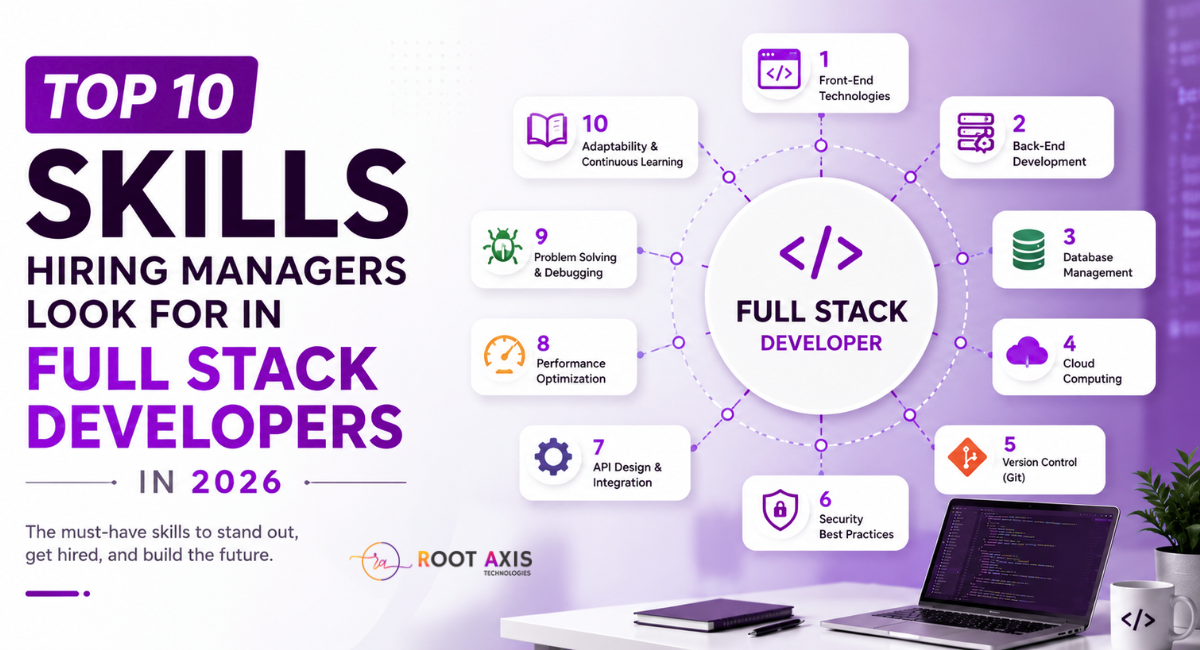
Top 10 Skills Hiring Managers Look for in Full Stack Developers in 2026
By Rootaxis Team · Updated May 2026
What This Guide Covers
- Full stack developer skills hiring managers prioritise in 2026
- Why a structured full stack developer roadmap matters
- Top 10 skills evaluated in technical and HR interviews
- How to demonstrate each skill through your resume and portfolio
- What separates shortlisted candidates from those who get offers
- Frequently asked questions about full stack developer hiring in 2026
The demand for skilled full stack developers continues to grow in 2026, but so does the competition. Companies across every industry are hiring for these roles, yet a significant number of applicants never make it past the first screening.
What Full Stack Development Looks Like in 2026
A full stack developer is someone who can build and maintain both the client-facing side of an application and the server-side logic that powers it. In 2026, that definition has expanded to include cloud deployment, containerisation, API architecture, security fundamentals, and increasingly, the ability to integrate AI-driven features into production systems.
The Top 10 Full Stack Developer Skills
1.Frontend Framework Proficiency
React remains the dominant frontend framework in 2026, with Vue and Angular maintaining strong presence in enterprise environments.
2.Backend Development and API Design
Node.js, Python with FastAPI or Django, and Java with Spring Boot are the most frequently listed backend requirements.
3.Database Design and Query Performance
Both relational databases (PostgreSQL, MySQL) and NoSQL solutions (MongoDB, Redis) appear in full stack roadmaps for good reason.
4.Cloud Platform Familiarity
AWS, Google Cloud, and Microsoft Azure are central to how most applications are deployed in 2026.
5.Version Control and CI/CD Workflow
Git proficiency is a baseline expectation. Experience configuring CI/CD pipelines using GitHub Actions or GitLab CI is now expected even at entry level.
6.Testing Practices and Code Quality
Hiring managers value candidates who write unit and integration tests as a natural part of development using tools like Jest, Cypress, or Pytest.
7.Security Awareness and Safe Coding Practices
Every full-stack developer is expected to understand the OWASP Top 10 vulnerabilities and implement proper input validation and authentication.
8.Containerisation and DevOps Fundamentals
Docker has become a standard tool. The ability to write a Dockerfile and run multi-container applications with Docker Compose is now essential.
9.Communication and Cross-Functional Collaboration
Developers who communicate technical decisions clearly and document their work in ways that help teammates progress fastest in their careers.
10.Adaptability and a Continuous Learning Habit
Hiring managers in 2026 explicitly evaluate whether a candidate has a genuine habit of learning — not just whether they have learned a lot.
How to Demonstrate These Skills
- Build a portfolio with context and decisions: Explain the problem each project solved and what you learned.
- Write about technical challenges you have solved: A short article demonstrates communication skill and technical depth simultaneously.
- Follow a structured roadmap: Shows hiring managers that your learning is intentional rather than reactive.
- Prepare specific stories for every skill: Hiring managers remember specific stories far more clearly than general capability claims.
Frequently Asked Questions
What are the most important skills to learn first?
- Frontend fundamentals (HTML, CSS, JavaScript) and a core framework like React form the foundation.
- Pair that with backend basics in Node.js or Python and an understanding of relational databases.
- Build a small end-to-end project as early as possible.
How long does it take to develop job-ready skills?
- A focused and consistent effort typically produces job-ready skills within six to twelve months.
- Thirty to sixty minutes of deliberate practice every day compounds significantly faster than sporadic long sessions.
Do soft skills really matter in a full stack developer interview?
- Yes, significantly. Strong communicators with solid fundamentals consistently outperform technically brilliant candidates who struggle to collaborate.
- Communication is assessed in every round, including technical rounds.
Is a computer science degree required?
- A degree is not required, but understanding of CS fundamentals is expected even from self-taught developers.
- Hiring managers care about evidence of real capability — how it was developed matters far less than whether it can be demonstrated.
Conclusion
The full stack developer skills that hiring managers prioritise in 2026 go far beyond writing code in multiple languages. They reflect a broader professional maturity — the ability to build reliable systems, communicate decisions clearly, and keep growing in a field that never stops evolving.
The developers who stand out are not always the most technically advanced. They are the ones who have taken the time to develop the right skills, built projects that demonstrate those skills in context, and learned how to talk about their work convincingly.
Start building your skills and following your roadmap today — because the companies interviewing tomorrow are already shortlisting the developers who started yesterday.