Python Libraries Every Data Science Beginner Should Know
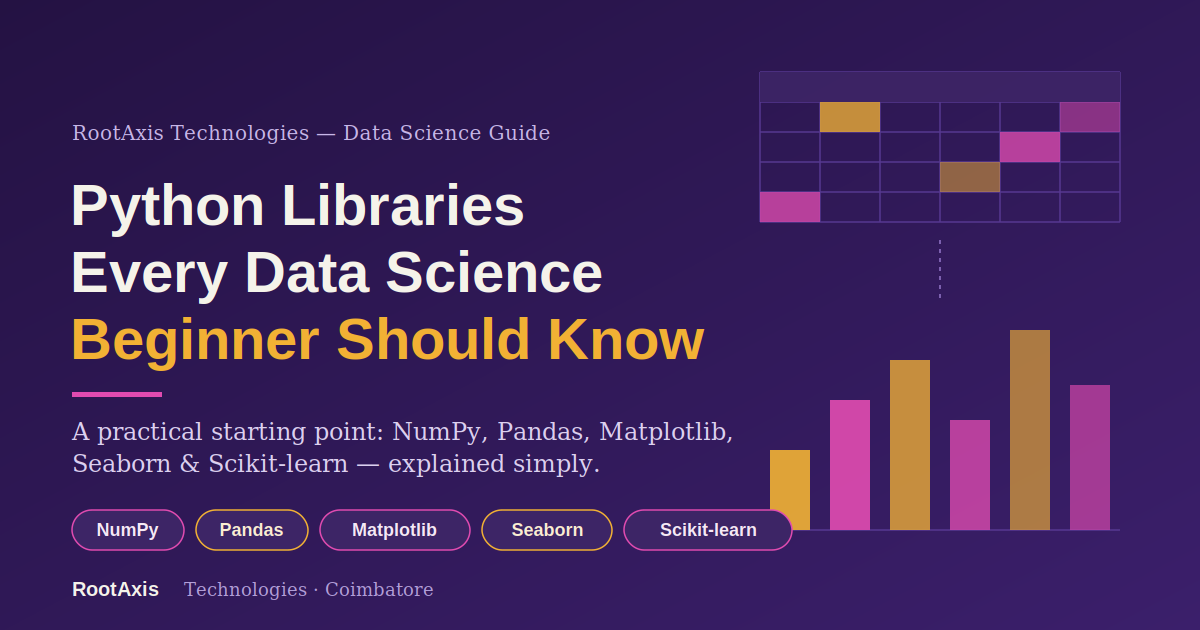
Python is the most popular language for Data science not just because it’s easy to learn, but because of its powerful ecosystem of libraries built specifically for data handling, math, and visualisation. If you’re starting your Data Science journey, these are the libraries you’ll use almost every single day.
Table of Contents
- Why Python for Data Science?
- NumPy – Numerical Computing
- Pandas – Data Manipulation
- Matplotlib & Seaborn – Data Visualisation
- Scikit-learn – Machine Learning
- Other Libraries Worth Knowing
- Suggested Learning Order
- Frequently Asked Questions
- Final Thought
Why Python for Data Science?
Python’s simple, readable syntax lets beginners focus on data concepts instead of fighting complicated code. But the real power comes from its libraries pre-built collections of functions that handle everything from number-crunching to building AI models, so you don’t have to write everything from scratch.NumPy Numerical Computing
NumPy (Numerical Python) is the foundation for almost every other Data Science library.
- Works with arrays a faster, more efficient way to store and process large sets of numbers compared to regular Python lists.
- Handles complex mathematical operations: matrix multiplication, linear algebra, statistics, and more.
- Extremely fast because its core operations run in C under the hood.
Where you’ll use it: whenever you need to do heavy numerical calculations resizing data, running mathematical formulas, or preparing data for machine learning models.
Pandas Data Manipulation
If NumPy handles numbers, Pandas handles tables. It’s the library you’ll use to clean, organise, and explore real-world datasets.
- Works with two main structures: Series (a single column of data) and DataFrame (a full table, like an Excel sheet).
- Makes it easy to read data from CSV, Excel, SQL databases, and more with just one line of code.
- Handles missing values, duplicates, filtering, grouping, and merging datasets effortlessly.
Where you’ll use it: almost every Data Science project starts with Pandas loading the raw data, cleaning it up, and getting it ready for analysis.
Matplotlib & Seaborn – Data Visualisation
Numbers alone don’t tell a story visuals do. That’s where these two libraries come in.
- Matplotlib is the foundational plotting library line charts, bar graphs, scatter plots, histograms, all customizable in detail.
- Seaborn is built on top of Matplotlib but makes statistical visualisations (like heatmaps and correlation plots) much easier and better-looking with less code.
Where you’ll use it: exploring patterns and trends in your data, and presenting your findings clearly to others a skill recruiters specifically look for.
Scikit-learn Machine Learning
Once your data is clean and understood, Scikit-learn is usually the next step it’s the go-to library for building and testing machine learning models.
- Offers ready-to-use algorithms for classification, regression, and clustering.
- Includes tools for splitting datasets, evaluating model accuracy, and tuning performance.
- Beginner-friendly syntax most models can be trained in just a few lines of code.
Where you’ll use it: building your first predictive models, like predicting house prices or classifying customer churn.
Other Libraries Worth Knowing
LibraryWhat It’s ForTensorFlow / PyTorchDeep learning and neural networks (for later stages)Statsmodels Statistical modeling and hypothesis testing Plotly Interactive, web-based visualizations Beautiful SoupWeb scraping to collect data
Suggested Learning Order
For a beginner, this progression usually works best:
- Python basics (variables, loops, functions)
- NumPy — arrays and basic math operations
- Pandas — loading and cleaning real datasets
- Matplotlib/Seaborn — visualising your findings
- Scikit-learn — building your first ML model
Frequently Asked Questions
1. Do I need to learn all these libraries before starting a Data Science course?
No. Most structured courses teach them in the right order alongside real projects. Basic Python knowledge is enough to get started.
2. What’s the actual difference between NumPy and Pandas?
NumPy works with raw numerical arrays and is best for mathematical operations. Pandas works with labelled, table-like data (rows and columns) and is best for real-world datasets with mixed data types.
3. Is Seaborn better than Matplotlib?
Not better different. Seaborn is built on Matplotlib and is faster for statistical charts, but Matplotlib gives you more fine-grained control when you need custom visualisations.
4. Can I get a Data Science job knowing only these libraries?
These are the essential foundations. Depending on the role, you may also need SQL, a cloud platform, and possibly deep learning frameworks like TensorFlow but Pandas, NumPy, and Scikit-learn cover the core skill set most entry-level roles expect.
5. How long does it take to get comfortable with these libraries?
With consistent, hands-on practice using real datasets, most beginners get functional in 2-3 months though real fluency comes from working on multiple projects over time.
Final Thought
You don’t need to memorise every function in these libraries what matters is understanding what each one is for and practising with real datasets. Start with NumPy and Pandas to build your data-handling foundation, add visualisation skills with Matplotlib and Seaborn, and once you’re comfortable, Scikit-learn will open the door to your first machine learning projects.
Written for RootAxis Technologies — Practical IT Training & Internship Programs in Coimbatore.