MERN vs Python Full Stack - Which One Should You Learn First in 2026?
Confused between MERN and Python Full Stack? Compare job demand, salary, learning curve, and career paths to pick the right stack to start your developer journey in 2026.
If you’re starting your coding journey in 2026, this is probably the first big decision you’ll face: MERN Stack or Python Full Stack — which one first?
Both are in huge demand. Both can get you a great job. And both have loyal communities telling you theirs is “the one.” So instead of picking a side, let’s break down what each stack involves, where the jobs are, and how to decide based on your goals—not internet opinions.
Table of Contents
- What Is the MERN Stack?
- What Is Python Full Stack?
- MERN vs Python — Side-by-Side Comparison
- Job Market & Salary in India
- Which One Is Easier to Learn First?
- Which Should You Choose?
- Learn Full Stack Development at RootAxis
- FAQs
What Is MERN Stack?
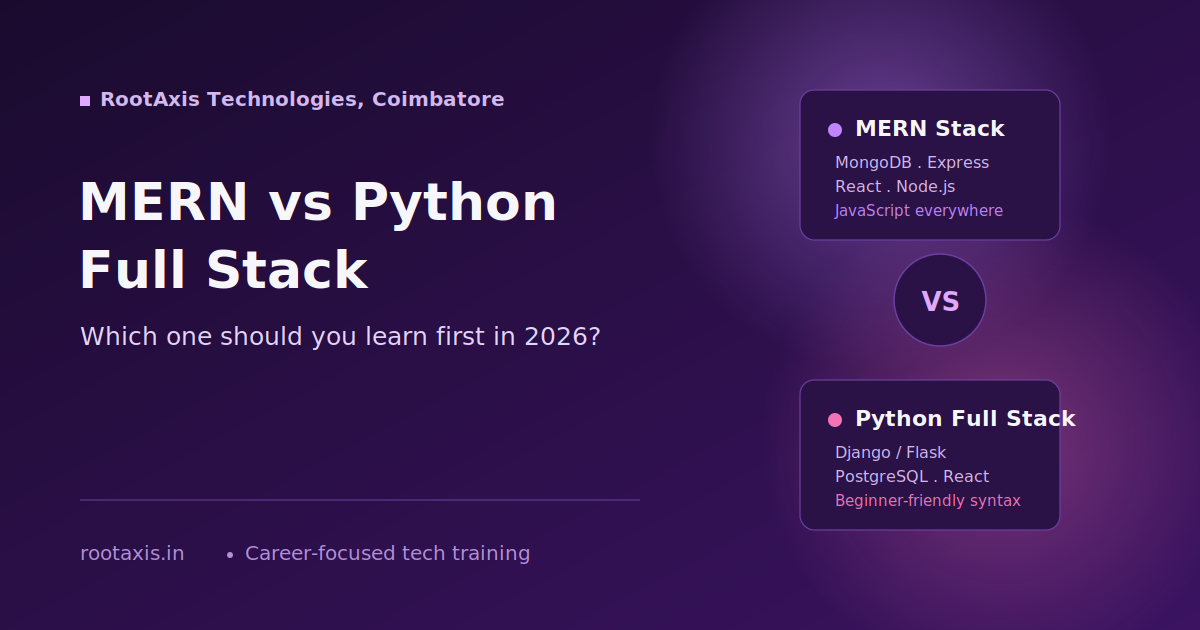
MERN stands for MongoDB, Express.js, React.js, and Node.js — a full JavaScript stack, meaning you write both frontend and backend code in the same language: JavaScript.
- MongoDB — a NoSQL database for storing data
- Express.js — backend framework for building APIs
- React.js — frontend library for building user interfaces
- Node.js — JavaScript runtime that powers the backend
MERN is popular for building fast, interactive web apps — dashboards, SaaS products, e-commerce platforms, and startups love it because one language (JavaScript) covers the entire stack.
What Is Python Full Stack?
Python Full Stack typically means using Python (with Django or Flask) for the backend, paired with HTML/CSS/JavaScript or a frontend framework like React, and a database like PostgreSQL or MySQL.
- Django/Flask — backend frameworks known for speed of development and strong security defaults
- Python — readable, beginner-friendly syntax
- Often paired with Data Science, AI/ML, and automation—Python is the same language used across those fields.
Python Full Stack is a strong choice if you want backend depth or if you are eyeing a future move into Data Science or AI, since the language carries over directly.
MERN vs Python — Side-by-Side Comparison
FactorMERN StackPython Full StackLanguage(s) to learnJavaScript onlyPython + HTML/CSS/JSLearning curveModerate — JS quirks can trip up beginnersGentle — Python syntax is more readableBest forInteractive UIs, startups, SaaS productsBackend-heavy apps, data-driven appsCareer crossoverFrontend-heavy roles, JS ecosystemData Science, AI/ML, automationJob market in IndiaVery high demand, especially startupsHigh demand, especially product & enterprise companiesDevelopment speedFast for UI-heavy appsFast for backend logic (Django’s “batteries included”)
Job Market & Salary in India
Both stacks are consistently in the top hiring categories for freshers and junior developers in India:
- MERN developers are heavily hired by startups and product companies building modern web apps the JavaScript-everywhere approach means smaller teams can move faster, which appeals to lean startup hiring.
- Startups, enterprises, and product companies hire Python full stack developers, and Python’s dominance in AI/ML opens doors beyond web development.
Neither stack has a clear salary “winner” actual pay depends more on your project portfolio, problem-solving skills, and company size than the stack itself.
Which One Is Easier to Learn First?
If you’re a complete beginner, Python Full Stack is generally the gentler starting point — Python’s syntax is closer to plain English, which means fewer beginner errors and faster early confidence.
MERN has a slightly steeper initial curve because JavaScript has more quirks (asynchronous code, this binding, etc.), but once you’re comfortable, working in one language across the entire stack feels very efficient.
Which Should You Choose?
Here’s a simple way to decide:
- Choose MERN if you enjoy building interactive UIs, want to work at JS-first startups, or want a “one language, one ecosystem” workflow.
- Choose Python Full Stack if you want a gentler learning curve, are interested in eventually moving into Data Science/AI, or prefer backend-heavy problem solving.
- Can’t decide? Python Full Stack is the safer first stack for absolute beginners — it builds transferable skills for AI/ML careers too, so your first stack doesn’t lock you into just web development.
Either way — the stack matters less than your consistency in building real projects. Employers hire based on what you’ve built, not just what you “know.”
Learn Full Stack Development at RootAxis, Coimbatore
At RootAxis Technologies, our Full Stack Development courses cover both MERN and Python (Django) tracks with hands-on, project-based training — real client-style projects, 1-on-1 mentor support, and placement assistance, with small batches (10 students max) so you actually get guidance, not just recorded videos.
Not sure which stack fits your goals? Book a free career counselling session with our trainers and get a personalised recommendation.
Frequently Asked Questions
1. Can I learn both MERN and Python Full Stack eventually?
Yes, and many developers do over time. But start with one, build strong fundamentals and real projects, then expand — trying to learn both at once usually slows down progress on either.
2. Which stack is better for getting a job faster?
Both have strong hiring demand in India. Your project portfolio and problem-solving ability matter far more than which stack you picked first.
3. Is Python Full Stack useful if I want to move into Data Science later?
Yes — this is one of Python’s biggest advantages. The language, libraries, and logic carry over directly, making the transition into Data Science or AI/ML much smoother than switching from JavaScript.
4. Is MERN only useful for startups?
No. While startups love MERN for its speed, many mid-size and enterprise companies also use it, especially for customer-facing web applications and dashboards.
5. Do I need to know both frontend and backend to call myself a “full stack” developer?
Yes — full stack means you’re comfortable working across the frontend, backend, and database layers of an application, even if you have a stronger preference for one side.
6. Which stack does RootAxis recommend for absolute beginners?
For students with zero coding background, we generally recommend starting with Python Full Stack for its gentler learning curve — but our counselling session looks at your specific goals before recommending a track.